

Why Unified SASE is the Network Security Platform Your Business Needs Now
Hybrid work, cloud applications and rising cyber threats are exposing the limits of traditional network security architectures.
The way organisations connect users to applications has changed more in the last five years than in the previous two decades.
What began as a rapid shift during the pandemic has become a permanent operating model. Employees now work from everywhere, applications run across multiple clouds and the internet has effectively become the corporate backbone.
As a result, security teams face growing tool sprawl, operational complexity and an expanding attack surface.
In this article, we explore why traditional network and security architectures are struggling to keep up and why Unified Secure Access Service Edge (SASE) is emerging as a simpler platform approach to secure connectivity.
Key takeaways.
- Traditional network architectures struggle to support hybrid work and cloud-based applications.
- Security stacks built from multiple tools create operational complexity and visibility gaps.
- Unified SASE platforms combine networking and security into a single architecture.
- Managed SASE services allow organisations to adopt this model without operating the platform themselves.
What’s driving the shift to SASE?
Several structural shifts have made the traditional “castle and moat” security model increasingly ineffective.
Hybrid Work
Employees, partners and contractors now connect from homes, branch offices and on the road. Backhauling traffic through a central data centre just to apply security controls introduces latency, complexity and cost.
Cloud Applications
SaaS and public cloud adoption mean many critical applications now sit outside the corporate network. Organisations must securely connect users to these applications over the internet rather than relying on private infrastructure.
Evolving Threats
Ransomware, phishing and credential theft increasingly target identities and exploit gaps between networking and security tools. Fragmented security stacks create opportunities for attackers to move laterally or remain undetected.
Tool Sprawl
Many organisations rely on multiple technologies – firewalls, VPNs, secure web gateways, CASB tools, Zero Trust access controls and SD-WAN to secure users and applications.
Each introduces its own management console, policies and logs.
Over time, this creates fragmented visibility and growing operational complexity for security teams.
SASE emerged as a response: merge software defined networking with cloud delivered security, and deliver them as a platform rather than a toolbox of point products.
The case for a security platform.
Most security teams do not lack tools – they have too many.
A platform approach simplifies operations while strengthening protection.
- Consolidated controls bring networking, remote access and cloud security together under one policy framework.
- Improved visibility provides a unified view of users, devices and applications across environments.
- Simpler operations reduce management overhead and speed investigations.
- Stronger security allows threat intelligence and enforcement to work together across the platform.
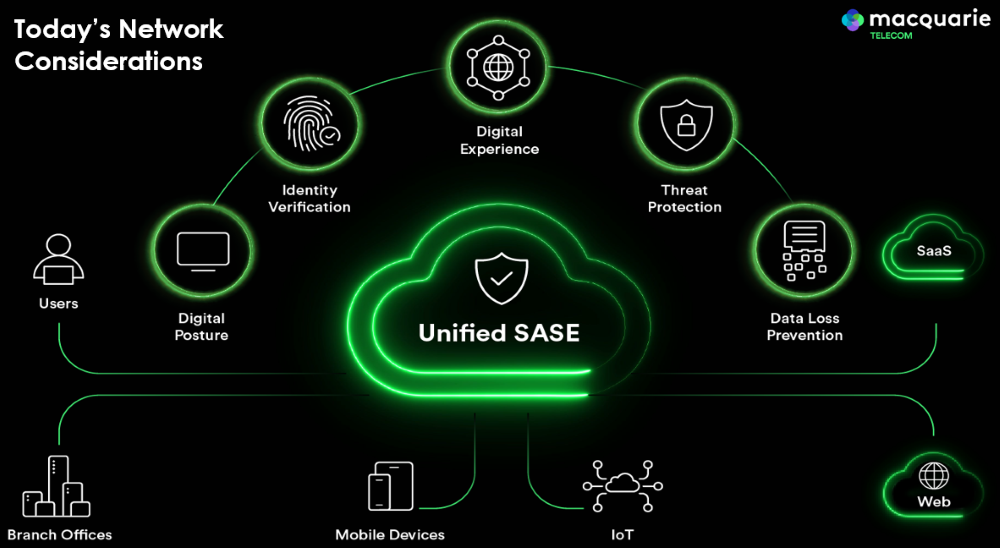
Macquarie Telecom’s Unified SASE solution, powered by Fortinet, combines SD-WAN, with cloud delivered security services like secure web gateway (SWG), cloud based security broker (CASB) and zero trust network access (ZTNA and next-generation firewall capabilities into a single platform delivered on-premises, in the cloud or as a managed service.
From business challenges to SASE outcomes.
Across organisations, the same challenges appear repeatedly.
Unified SASE provides a practical way to address them.
Slow applications over VPN.
Integrated SD-WAN and local internet breakout improve SaaS performance while maintaining consistent security controls.
Too many security tools.
A consolidated platform reduces the number of systems to manage and simplifies policy management.
Hybrid work replacing VPN.
Zero Trust Network Access enables application-level access based on identity and device posture rather than full network connectivity.
Limited visibility across environments.
A unified security fabric connects branch, data centre, cloud and remote users through shared analytics and telemetry.
How Fortinet’s Unified SASE approach is different.
Fortinet’s architecture is built around convergence:
- One security operating system powers SD-WAN, firewall, secure web gateway and Zero Trust access.
- Consistent Zero Trust principles ensure identity-aware access and application-level policies.
- Inline security at the edge applies controls close to users and applications, reducing latency and blind spots.
- Designed for managed delivery, enabling consistent deployment and continuous monitoring.
Macquarie Telecom wraps this platform with Australian based sovereign infrastructure, implementation, carrier grade connectivity and on-shore 24×7 operational support.
Three Conversation Starters for your Own Organisation.
If you’re considering how to evolve your network and security architecture, these questions can help frame the discussion internally:
- What would it take to move away from backhauling all internet traffic through a central data centre – without weakening security?
This goes to the heart of SD‑WAN, local breakout and cloud‑delivered security, and forces you to think about where inspection and control should actually live in a cloud‑first world.
- How many separate tools currently sit between a user and a SaaS application, and who owns each of them?
If the answer is “quite a few”, a platform approach can simplify ownership and operations.
- If a critical SaaS app stopped working right now for remote users, how quickly could we pinpoint whether it’s a network, identity, security or application issue?
Unified SASE is as much about observability, troubleshooting and actionable insights as it is about blocking threats.
Customer questions we’re hearing.
When organisations begin evaluating SASE, a few common questions often emerge.
Can we adopt SASE gradually or is it an all-or-nothing transformation?
Unified SASE can be rolled out step by step – for example starting with SD-WAN and cloud security for selected sites, then extending Zero Trust access to remote users.
How does this fit with our existing firewalls and SD-WAN?
A well-designed SASE roadmap looks at what can be reused, where integration is possible and where consolidation makes sense over time.
Who manages this day to day?
This is where a managed service provider can add value by designing the policy framework, operating the platform 24×7 and providing clear reporting back to internal teams.
Where to from here?
If your network and security stack is starting to feel like a collection of band‑aids on top of each other, Unified SASE offers a cleaner, more strategic path forward.
Macquarie Telecom’s Unified SASE solution powered by Fortinet combines:
- A converged networking and security platform
- Zero Trust access for users, sites and applications
- Australian-based design, deployment and 24×7 operational support
If you would like to explore what a SASE roadmap could look like for your organisation, our team can help assess your current architecture and identify where a unified platform could deliver the greatest impact.